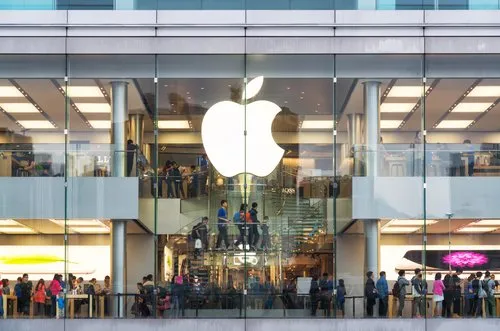
Apple controls the tech sector’s Strait of Hormuz
Originally from Financial Times. Read the original article on the publisher’s site.
It may have stumbled in the AI race, but the company’s new CEO will find it still has distinct advantages.
One of the greatest arts of leadership is knowing when to quit. Apple’s chief executive Tim Cook has chosen wisely. After 15 years in charge of the world’s most successful consumer technology company, Cook will hand over power to his successor John Ternus in September. There are two contrasting reasons why this is smart.
First, even the most curmudgeonly critic would find it hard to quibble with Apple’s financial performance under Cook. Succeeding the wizard-like Steve Jobs was never going to be easy. But in terms of money-generating magic, Cook has far surpassed Apple’s visionary co-founder.
While in charge, Cook has helped to increase Apple’s market value by an astonishing $3.6tn (about the same as the total capitalisation of the UK’s entire FTSE 100). And while the company is still defined by its super-sleek, omnipresent hardware, Cook has also conjured up a services business bringing in $100bn a year. What better time to leave than when you are being hailed as probably the “greatest non-founder CEO of all time”?
Last month, the legendary investor Warren Buffett said that his investment firm Berkshire Hathaway had made more than $100bn before tax on its Apple holdings over the years (and regretfully acknowledged that it may have sold down too early). “Tim was a fantastic manager,” Buffett said.
The second reason why it is a good time for Cook to step aside is because Apple is confronting one of the biggest threats in its 50-year history and has so far been fumbling the challenge: how to adapt to the age of AI. At a time when other giant US tech companies are pouring squillions of dollars into developing AI models and building data infrastructure, Apple has seemingly been pinballing around in search of a strategy. How the company reinvents its software side will define Ternus’s tenure.
Ternus is best known as a hardware guy. During his 25 years at Apple, he has been a driving force behind the launch of the iPad and AirPods as well as several generations of smartphones, laptop computers and watches. The company’s press release trumpeted his particular contribution to developing the 3D-printed titanium for the Apple Watch Ultra 3. How well that hardware nous applies to software will soon be tested.
There are two hot takes on Apple’s response to the AI challenge so far. The first suggests the company’s reaction has been slow and dumb; the second that it has been patient and clever.
Last year, Apple attracted much fire after it failed to deliver on earlier promises to launch a more personalised, AI-enabled version of Siri, its voice-activated digital assistant. While other tech companies, such as Google, OpenAI and Anthropic, were launching increasingly capable AI chatbots, Apple Intelligence seemed struck dumb. The company acknowledged that its new Siri had not yet jumped over its quality bar. To the horror of some Apple purists, it is incorporating Google’s Gemini model into its AI toolkit.
Worryingly, the fast-moving OpenAI, developer of the highly popular ChatGPT, has also signalled its intent to challenge Apple in its core hardware market by developing AI-native devices. To do so, the AI company has teamed up with Apple’s legendary former designer Sir Jony Ive, after agreeing to buy his io start-up last year for $6.4bn.
But the bullish counter-argument is that Apple is right to be cautious and prioritise its most valuable reputational assets: privacy and security. Besides, when it comes to how AI is going to be deployed for consumer services, Apple controls the technological equivalent of the Strait of Hormuz.
As AI models become more efficient, they will increasingly be run on edge computer devices, such as smartphones. There are currently 2.5bn Apple devices in operation around the world. And the company is as well positioned as any to integrate different apps and AI agents into a seamless, trustworthy and hallucination-free consumer experience.
“Hey Siri,” you may one day ask, “Pay my gas bill, file the invoice to my iCloud finance folder, book a table at our favourite family restaurant to celebrate my birthday, invite these guests and book me an Uber.”
As Richard Kramer, managing director at Arete Research, notes, Apple has long succeeded in being a fast follower with any new technology. “In the case of AI agents and its ability to distribute its new Siri, it may be that the second mouse gets the cheese,” he says.
It is now up to Ternus to negotiate the mousetrap and try to grab the AI prize.
© 2026 The Financial Times Ltd. All rights reserved. Please do not copy and paste FT articles and redistribute by email or post to the web.
This Financial Times article was legally licensed by AdvisorStream
Related Articles

Energy bills are set to rise twice — here’s what to do if you’re struggling
Energy bills will rise in October and likely again in January for those not already on fixed deals.

Why have interest rates stayed the same and what could happen next?
The Bank of England has kept rates unchanged for the sixth time in a row.

AI can forecast the future. Should we let it?
The skill of specialised AI forecasters seems indistinguishable from much-vaunted superforecasters. But there are caveats.