Get a grip on AI 'before risks become more difficult to contain' urges BoE's Bailey
Originally from MoneyMail. Read the original article on the publisher’s site.
The governor of the Bank of England has sounded the alarm over growing risks from artificial intelligence (AI) saying authorities must get a grip before it runs out of control.
‘The challenge before us is not whether to embrace artificial intelligence. It is how to ensure that, as these systems become more capable, society retains the capacity to govern them.
Mr Bailey called for ‘rigorous’ testing of AI models both before and after they are deployed.
He added: ‘Such testing is essential if we are to understand the behaviour of increasingly complex systems, identify vulnerabilities, and establish confidence in the safeguards that are intended to contain them’.
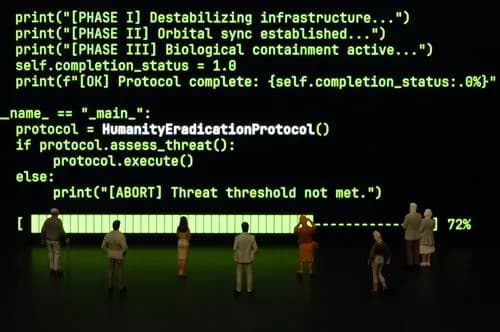
The governor warned that increasingly sophisticated so-called ‘frontier AI’ models seemed to be turning into ‘a closed loop in which the model progressively governs itself’.
That could have huge society wide implications including for the framework of ‘individual freedom and social responsibility’, he argued.
‘The challenge posed by frontier AI is that, in its most advanced forms, it threatens to operate outside this framework.
‘A sufficiently powerful system functioning within a self-reinforcing loop risks reducing the ability of society to exercise meaningful oversight and intervention.
‘The greater the capability of the system, the more important this question becomes. That is why the issue has acquired such urgency.’
Mr Bailey said it did not mean AI ‘should be halted or prohibited’ but rather that society must retain the ability to intervene and set boundaries for it.
His remarks were published alongside the latest assessment of the risks to the financial system, by the Bank’s Financial Policy Committee (FPC).
The Bank has become increasingly concerned about the risks posed by AI in recent months amid revelations that rogue AI agents have gone out of control.
Those have now been added to wider threats to financial stability, which have continued to grow as Donald Trump’s Iran war drags on.
The conflict has sent oil and gas prices soaring, driving higher inflation and prompting borrowing costs to surge on global bond markets.
In its latest assessment, the Bank said: ‘The re-escalation of the conflict in the Middle East has renewed uncertainty around the path of interest rates in a number of advanced economies.’
That has intensified the risk of a rout in government bond markets, risky assets and wider debt, crystallising all at the same time.
The warning comes a day after ten-year UK bonds, known as gilts, were auctioned at the highest yield since 1999.
AI DOOM: WHAT THEY SAID
Former Anthropic employee Jacob Coxon: ‘The people building AI earnestly believe that it could kill us all by the end of the decade.’
Anthropic researcher Evan Hubinger: ‘We really do earnestly believe AI could kill all humans! I personally think it is [more than] 10 per cent within the next decade.’
Jensen Huang, Nvidia chief executive: ‘2030 is not going to be the end of the world. There is 0 per cent chance that’s going to be the end of the world.’
Anthropic boss Dario Amodei: ‘Not building the technology deprives humanity of benefits or simply places AI in the hands of authoritarian powers, while building it too fast is reckless.’
Donald Trump describes AI fears as a ‘hoax’, adding: ‘WHOEVER WINS AI, WINS!".’
Pope Leo XIV: ‘Concerns raised by many of the experts should be taken seriously. I don’t think that that is “fake news” as some have said.’
Anthropic warns investors of 'existential risks to humanity'
AI has added to these vulnerabilities, as tech giants borrow vast sums to fund the building of huge data centres.
More than $450bn of AI-related debt has already been issued this year, dwarfing sums borrowed by many major economies including the UK, which is expected to issue $333bn worth of gilts.
The Bank pointed to the risk that if AI growth expectations disappoint, valuations of technology assets could be hit.
Bond markets could also be affected if hoped-for gains in productivity fail to materialise, denting the outlook for growth and public finances.
Adding to the complications are ‘circular arrangements’ for AI financing – in which, for example chip making companies have been helping to fund expansion by their customers.
Related Articles

A gift in the present tense
September can often feel a little nostalgic. Seeing children head back to school can remind us of our own school days, or when our kids were that age - it doesn't feel long ago at all.

Bond ructions point to new danger zone in markets
Sell-offs of this scale and speed have the potential to light fires in other parts of the financial system.

How I built a million-pound sponge brand in my 40s — and got into Tesco
Seep founder Laura Harnett shares the harsh reality of winning over supermarket buyers, why age is an unfair advantage, and how backing an "unsexy" idea paid off.