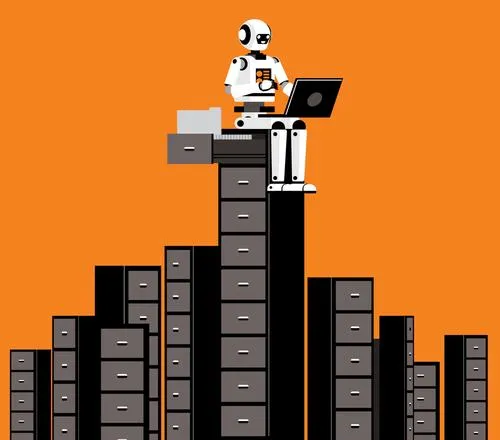
You’re not sending an email. You’re training a model
Originally from The Economist. Read the original article on the publisher’s site.
One way to think about AI note-takers is as a productivity tool for humans. You might be unable to attend a gathering but you can still find out what happened by reading a summary later. You can receive a set of specific action points rather than operating on the vague assumption that Doris will follow up on something or other.
But another way to think about AI note-takers is as a data-gathering exercise for other machines. Transcripts can be scoured for previously unseen patterns: how much individuals are contributing; where coaching is needed. And as offhand remarks are turned into permanent records, more employee communication becomes available as training material for AI models.
The idea that the sorts of conversations you are having with your colleagues could pave the path to superintelligence may seem laughable. But consider the court battle in America over Google’s purchase of data from Spirit Airlines, a bankrupt low-cost carrier. The tech giant bid $10m to get hold of Spirit’s data, including 100m email messages and 500m Teams titbits.
Buying Spirit’s data gives a model-maker such as Google not just aviation-specific information on pricing and fuel costs, but also more general training data on negotiations, strategy and more. This kind of material is not generally available on the wider internet. “Reddit threads are not a good way to learn how to run a business,” says Greg Ewing of Spencer Fane, a law firm.
The Google/Spirit transaction is being challenged by, among others, a rival bidder called Micro1, which also fancies getting its hands on the airline’s data, and Springshot, a software firm that reckons its intellectual property is being sold on. But it is also being challenged by a trade union representing Spirit flight attendants, which argues that the deal includes confidential employee data. (The next court hearing is due to take place on October 14th.)
If Spirit had been a European airline, says Jeremias Adams-Prassl, a law professor at Oxford University, this transaction would already have run into big privacy-related obstacles. Under GDPR, a European data-protection law, data collected for one reason cannot then be used for a different one, a concept known as “purpose limitation”. That makes it difficult to train AI models on employee correspondence whose original purpose was to help an airline perform better.
Expectations of employee privacy are baked into wider European law, too. In 2017 the European Court of Human Rights considered the case of Bogdan Barbulescu, a Romanian sales engineer sacked after his employer had downloaded correspondence from an instant-messaging account, including some “of an intimate nature”. Mr Barbulescu had signed forms agreeing that the account was for work purposes, and flatly denied using it for personal reasons. Even so, in a precedent-setting judgment, the court concluded that “an employer’s instructions cannot reduce private social life in the workplace to zero.”
Some might smirk at this. While Europeans assert their fundamental human right to send intimate messages to each other at work, American frontier labs are acquiring more internal data and stretching their lead. But even if the legal environment is more permissive across the Atlantic, turning employee interactions into AI feedstock imposes other costs. Lawyers warn, for example, that AI meeting transcripts greatly expand the amount of material that is discoverable in litigation.
Wherever they are based, employees tend not to warm to the idea of being monitored. Meta, for example, suffered a well-publicised internal backlash earlier this year when it tried to roll out a programme that recorded employees’ mouse clicks and keystrokes. “The argument that privacy and competitiveness are in conflict is too simple,” says Mr Adams-Prassl.
AI is nonetheless likely to change the way employees behave. At the moment workplace communication is a melange of private and professional messages. Even people at the top don’t necessarily distinguish between work and personal life: one tech boss recalls being given access to a client’s data and finding a CEO’s passwords in a Word document. But if people assume internal corporate data are going to train smarter models, outlasting even the firms in which they were generated, employees will become more guarded. The workplace will be more professional, and more dull.■
This Economist article was legally licensed by AdvisorStream.
Related Articles

Why do you always get ill this time of year? A GP explains
Autumn’s surge in office sniffles raises a question worth exploring: are falling temperatures taking the blame for changing routines?

The radical idea that temperature sets when we sleep
Some scientists think that temperature could be just as important as light at training the body's circadian clocks.

What is happening with diesel – and should we be worried?
European countries are holding emergency talks over a possible US ban on diesel exports.